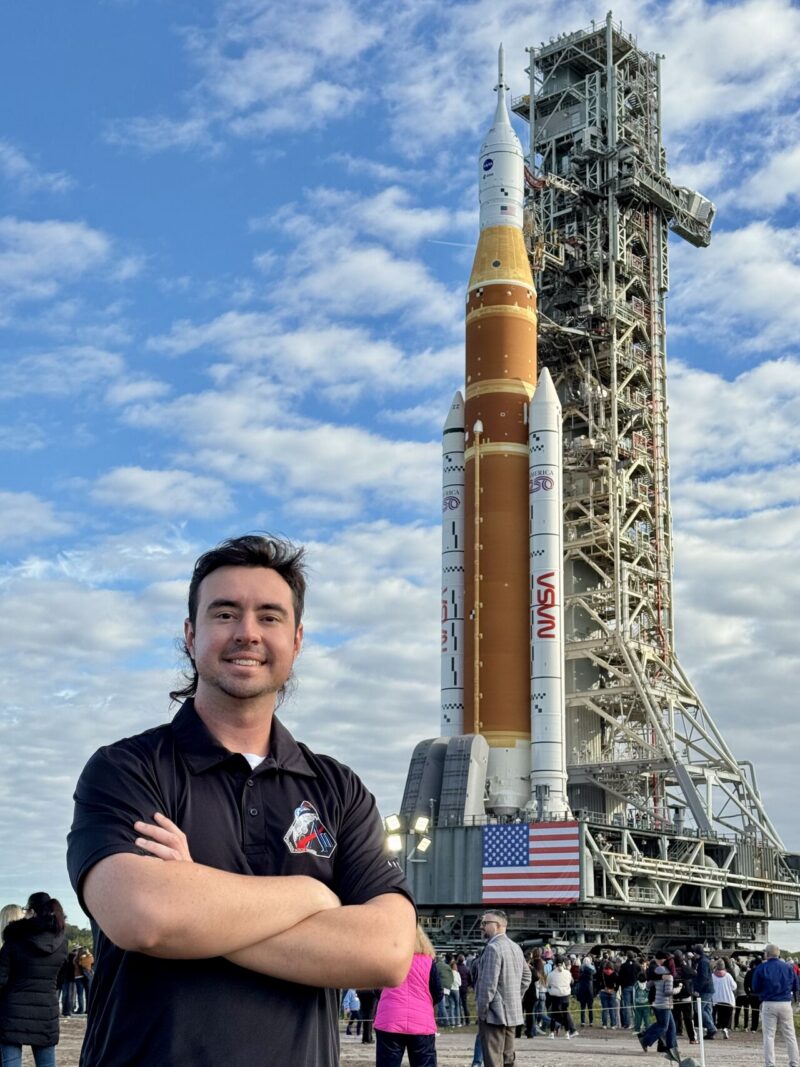
Meet Breanne Rohloff: Moving Rockets Before They Fly

Before a rocket ever lights up the sky, it has to move — very slowly, deliberately, and without room for error. That’s where Breanne Rohloff, a mechanical engineer at Amentum, comes in.
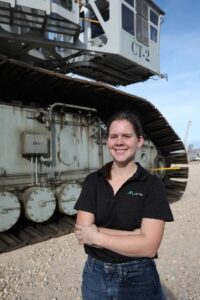
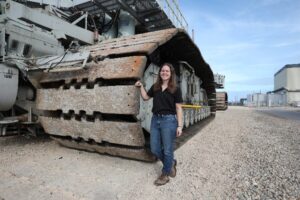
Breanne drives NASA’s crawler transporter, playing a critical role in moving rockets from the assembly building to the launch pad. These enormous, unique vehicles are essential to every successful launch.
The crawler is an engineering marvel. Designed to move millions of pounds, it travels at a carefully controlled pace, between 0.2 to 0.8 miles per hour, to keep rockets perfectly level on their journey to the pad. Every move is the result of months of preparation, inspections, and coordination across teams, with tens of thousands of components working together in real time.
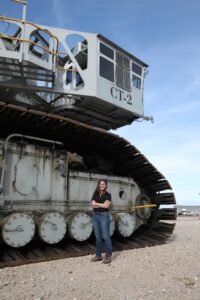
“A size reference that gets thrown around a lot is the top of the crawler – the lifting surface is as big as a baseball infield,” said Breanne. “The vertical height of the crawler can be anywhere between 20 and 26 feet, depending on how high our chassis is set from the jacking, equalizing and leveling system for the mount mechanisms.”
Breanne’s path to the crawler started with a lifelong curiosity about space and how complex machines work. While studying aerospace engineering, she joined Amentum as an intern and quickly found herself immersed in the world behind the launch — the systems, the planning, and the precision required long before countdown begins. That early hands-on experience opened the door to a career that puts her at the controls of one of the most iconic machines in spaceflight history.
Today, Breanne is playing a critical role in the upcoming Artemis II mission to the moon.
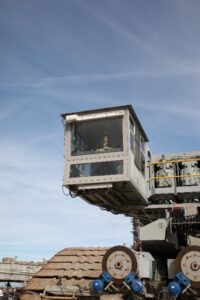
“Our crew is preparing for the launch by keeping the crawler ready to go, inspected, stocking a plethora of spare parts, and making sure the mobile launcher and the pad structures are primed and everything is in a receivable state,” said Breanne.
Breanne and her team are focused on overseeing maintenance, supporting system reliability, and guiding the vehicle during critical moves. It takes a team to drive the crawler: an engineer inside the control room who is jacking the height and equalizing and leveling the load, a crawler test lead monitoring the other systems, the driver in one of the two cabs, and finally technicians who are roving between the two engine rooms, pump room, and checking hydraulics or other ground systems.
As the only woman operator, Breanne is welcoming new, next-gen engineers learning to operate the crawler. Trust in your teammates on the crawler crew is essential.
“It’s wonderful to drive. The first time operating the crawler, the magnitude really hits you – you’re very humbled that you’ve been entrusted to do this,” Breanne added. “It’s such a feat that once you’ve been trained and trusted, you work extra hard to maintain your proficiency and continue your training.”
Her story is a reminder that big missions are powered by engineers like Breanne, whose precision and dedication make space exploration possible.