
Artemis: We are Going
Amentum and the Artemis Program: Powering Humanity’s Return to the Moon and Beyond
At Amentum, we are proud to support NASA on one of the most ambitious and inspiring missions of our time—the Artemis Program. This bold initiative is reigniting deep space exploration with the goal of landing the first woman and the first person of color on the Moon, establishing a long-term presence, and laying the groundwork for the first human missions to Mars.
As NASA’s largest services provider, Amentum provides the operational backbone that makes Artemis missions possible. From launch preparation and vehicle integration to astronaut readiness and mission assurance, our teams work shoulder‑to‑shoulder with NASA experts to advance the frontier of deep space exploration.
Artemis II: Preparing for the First Crewed Lunar Mission
Artemis II will be the first crewed flight of NASA’s deep‑space exploration architecture. This pivotal 10‑day mission will take four astronauts on a lunar flyby and return them safely to Earth. This mission builds on the success of Artemis I and marks the beginning of humanity’s return to deep space.
Under NASA’s Exploration Ground Systems (EGS) program, Amentum provides critical support for Artemis II, including:
- Maintaining and modernizing ground systems and launch infrastructure
- Integrating and testing the SLS and Orion vehicles
- Supporting launch operations, mission readiness, and recovery
- Providing systems engineering and technical expertise required for crewed spaceflight
Making Artemis a Reality
As the prime contractor at Kennedy Space Center (KSC) for NASA’s Exploration Ground Systems (ESG) Program, Amentum plays a vital role for Artemis by receiving all SLS and Orion flight hardware, assembling and integrating all components, conducting final test and checkout, transporting the integrated vehicle to the pad, supporting launch, and then recovering the Orion capsule after splashdown.
To enable these missions, the Amentum team helped NASA modernize and upgrade facilities and ground equipment at KSC ahead of the first Artemis launch. This included upgrades to the Vehicle Assembly Building, refurbishment of the Crawler Transporter 2, and modifications at Launch Pad 39B. The team is now supporting further modifications and preparation of ground systems and launch facilities for crewed Artemis missions.
Amentum also supports the development of the SLS and Orion spacecraft through our contracts at Marshall Space Flight Center, Johnson Space Center, Langley Research Center, and Glenn Research Center, in addition to providing project support at Stennis Space Center and Michoud Assembly Facility.
What Amentum Delivers
Amentum is a key partner enabling Artemis missions through specialized capabilities spanning engineering, launch operations, and human‑spaceflight readiness.
As NASA’s primary EGS partner, Amentum provides the infrastructure, systems, and operational expertise that bring Artemis missions to life. Our responsibilities include:
- Vehicle integration and processing
- Launch pad and ground systems operations
- Vehicle Assembly Building (VAB) sustainment
- Mobile Launcher and Crawler‑Transporter operations & maintenance
- Cryogenic, hypergolic, fluid, and gas servicing
- Console operations during countdown and launch
- Development and sustainment of SCCS, GFAS, and the Ground Launch Sequencer (GLS)
These capabilities ensure Artemis missions are assembled, tested, transported, and launched with precision and safety.
Human Spaceflight & Mission Operations
Amentum supports every aspect of crewed mission preparation and execution, including:
- Orion spacecraft ground processing
- Crew and service module preparation
- Launch readiness and mission assurance
- Close‑out crew operations assisting astronauts prior to launch
- Recovery operations after splashdown
Our teams help safeguard astronauts, spacecraft, and mission success.
Amentum provides the deep technical expertise required for complex missions:
- Systems engineering and integration
- Reliability, maintainability, and safety (RMS)
- Hazard and risk analysis
- Configuration management and compliance
Our engineering discipline ensures that every system, process, and interface meets NASA’s highest standards for crewed spaceflight.
Supporting Safe Human Spaceflight
NASA’s Orion spacecraft – the only deep space crew vehicle in the world – will carry astronauts on Artemis missions, launching atop the SLS, the most powerful rocket ever built. Amentum is helping ensure the Orion space capsule is as safe as possible, from launch to re-entry and through to splashdown.
The Orion capsule will travel at speeds greater than 25,000 mph through space, re-enter our atmosphere, and slow to about 325 mph before the Amentum Team-developed and tested Orion re-entry parachute system will deploy to slow the vehicle down to a safe landing speed of about 20 mph. Our team performed numerous tests around technical condition scenarios and fully certified the parachute system for approved use on NASA’s Orion crew vehicle.
Amentum teams from five NASA centers worked together to help develop and successfully test the Orion abort system. This critical system is designed to carry the crew to safety in the event of an emergency during launch or ascent.
The Journey Begins: Artemis I
The Artemis Program launched its first milestone mission with Artemis I, an uncrewed flight that successfully tested NASA’s Space Launch System (SLS) and Orion spacecraft as a fully integrated system. After launching on November 16, 2022, Artemis I traveled over 1.4 million miles beyond the Moon, orbited the lunar surface for six days, and returned safely to Earth on December 11. This mission was the critical first step in a series of increasingly complex journeys that will bring humans back to the Moon and beyond.
Building the Future: Long‑Term Lunar Infrastructure
In addition to supporting the Artemis Program, Amentum plays a key role in advancing deep-space exploration efforts through:
- Ground systems modernization
- Digital engineering and data integration
- Logistics and sustainment planning
- Infrastructure operations for long‑duration lunar programs
Amentum is also supporting Gateway – humanity’s first space station to orbit the moon. Amentum is actively involved in designing and testing the Habitation and Logistics Module (HALO), a crucial element that will provide astronauts with a pressurized habitat equipped with full communications, navigation, thermal control, and life support systems. Our team is working to develop and validate critical life-support technologies that will safeguard astronaut crews during extended missions beyond Earth’s orbit.
Artemis Spacesuit Technology Development and Validation
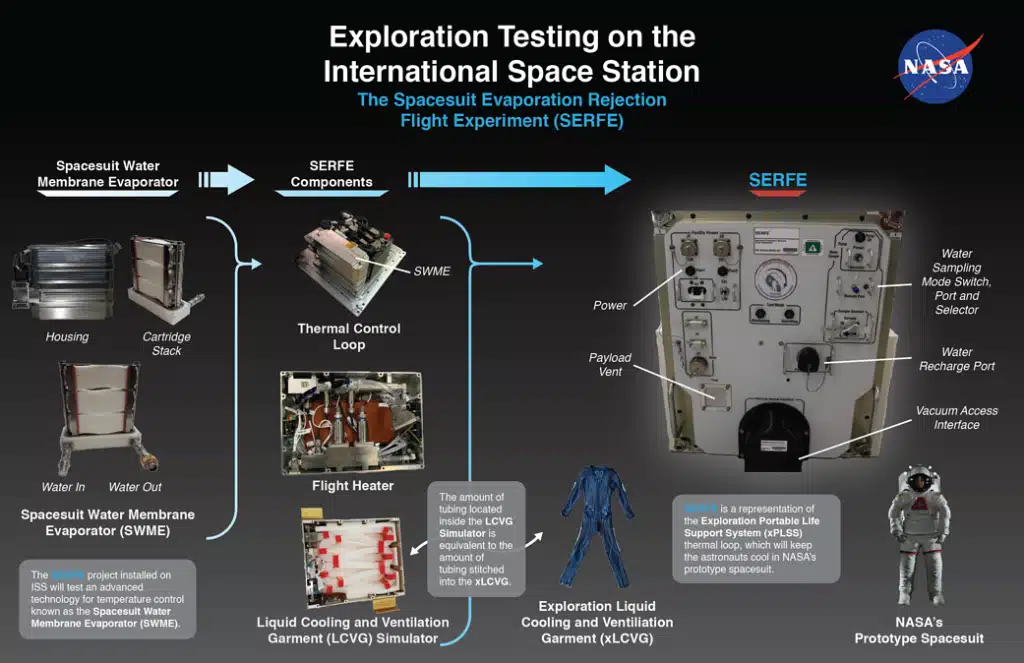
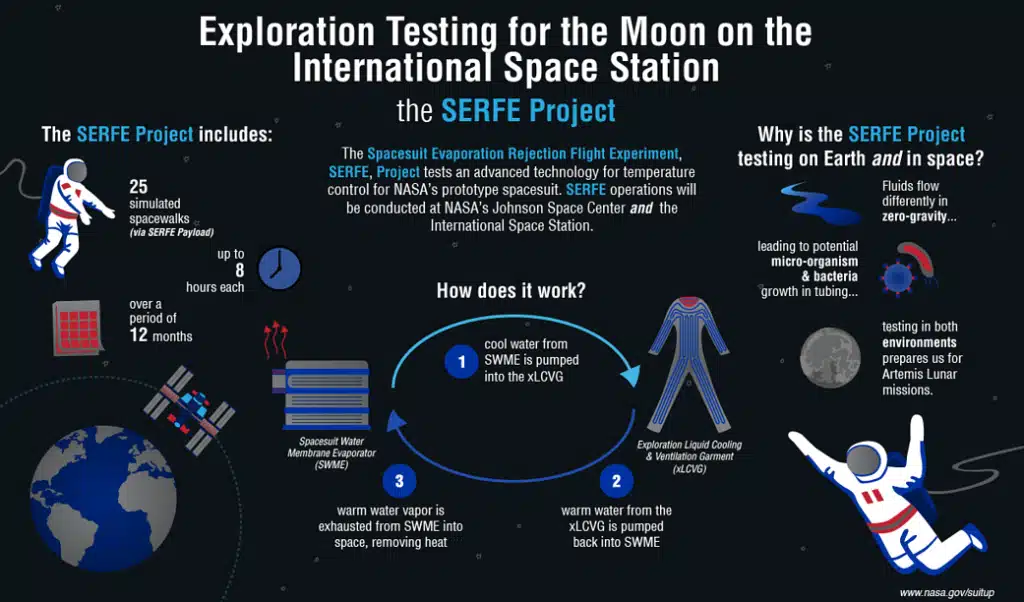
With average temperatures on the moon ranging from -298 degrees F in shadow to 224 degrees F in the sun, such a wide temperature range poses a problem for moon-walking astronauts. To address this issue, Amentum worked with NASA to develop the Spacesuit Evaporation Rejection Flight Experiment (SERFE). SERFE was designed to evaluate and demonstrate newly developed active thermal control technology called the Suit Water Membrane Evaporator (SWME) to protect suited astronauts from extreme temperatures. The SERFE Flight unit flew on the ISS for 18 months, simulating 25 eight-hour extravehicular activities (EVAs), while the SERFE Ground unit simultaneously completed 25 “EVAs” here on Earth. The Ground unit is currently simulating a 3-year lunar suit stowage period that ends in March 2025 in the Portable Life Support System (PLSS) Development lab.
Leveraging technology from the Artemis xEMU spacesuit development program, our team is collaborating with NASA and commercial spacesuit providers to provide safe, durable, flexible, and comfortable spacesuits for use on the moon, both for intravehicular and extravehicular activities.
Keeping Cool in Space
As NASA embraces commercial partnerships to optimize spacesuit technology as part of the Artemis program, the Spacesuit Evaporation Rejection Flight Experiment (SERFE) payload continues to be tested onboard the International Space Station (ISS). SERFE is designed to evaluate and demonstrate active thermal control technology in the microgravity environment of the International Space Station. At NASA’s Johnson Space Center in Houston, engineers have been performing the exact same test on the ground on an identical SERFE unit.
Beyond Artemis
VIPER Autonomous Lunar Rover
The Volatiles Investigating Polar Exploration Rover, or VIPER, was NASA’s Artemis robotic lunar rover designed to traverse the extreme environment of the Moon’s South Pole in search of frozen water and other potential resources. Our robotic engineers at Johnson Space Center directly supported the NASA team in VIPER’s systems engineering, integration, and testing, as well as the design of structural elements, motor controllers, and lights.
*Above photos courtesy of NASA